


The funding landscape just changed. Your website needs to keep up.
In 2026, nonprofits are navigating one of the most challenging funding environments in a generation. Federal grant terminations, the expiration of ARPA funds, and sweeping cuts to programs like AmeriCorps and TRIO have left organizations scrambling to replace revenue that was woven into their operational baselines. One in three nonprofit service providers experienced a government funding disruption in the first half of 2025 alone.
For organizations that have historically relied on federal and foundation funding, the message is clear: you need to diversify. Individual donors, corporate partners, earned revenue, program participants finding you through search — these channels matter more than ever. And they all run through your website.
The problem is, most nonprofit websites weren't built for this moment. They were built to look professional and house basic information. Looking professional and actually converting visitors into supporters, donors, and partners are two very different things. After thirteen years of building websites for mission-driven organizations, we've identified five patterns that consistently separate sites that generate inquiries from sites that don't.
1. No clear entry point for different audiences
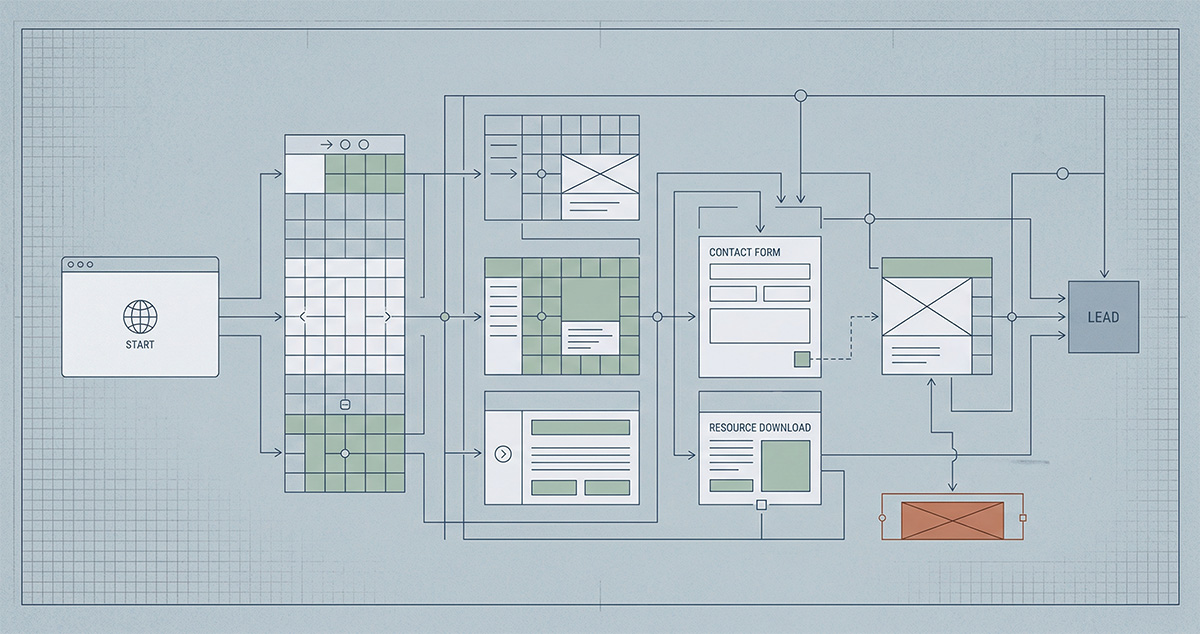
Nonprofits serve multiple audiences — donors, grantees, program participants, volunteers, media, partner organizations. Most nonprofit websites treat the homepage as the front door and expect every visitor to figure out where to go from there.
The fix isn't complicated: create dedicated landing pages or clear navigation paths for your two or three primary audiences. A foundation's site should make it immediately obvious whether you're a potential grantee, a current grantee, or a donor. A healthcare nonprofit should separate patient resources from institutional partnership information. When visitors see themselves reflected in the navigation, they stay longer and take action.
This matters more now than it used to. As organizations pivot toward individual giving and corporate partnerships, the website needs to speak to those audiences directly — not just the program officers who reviewed your last grant application.
2. The "About" page is doing all the heavy lifting
On most nonprofit sites, the About page gets the most traffic after the homepage. That's not inherently bad, but it becomes a problem when About is the only page with substantive content about what the organization does and why it matters. If your service or program pages are thin — just a paragraph and a stock photo — visitors who land on them from search will bounce immediately.
Each service or program you offer should have a dedicated page with enough content to (a) explain what it is, (b) explain who it's for, (c) show proof that it works, and (d) tell the visitor what to do next. This isn't just good UX — it's the foundation of SEO. Google can't rank you for "youth mentorship program Portland" if you don't have a page about your youth mentorship program.
3. No calls to action beyond "Donate"
Donation buttons are important. But not every website visitor is ready to give money, and if "Donate" is the only clear action on the site, you're losing everyone who came for a different reason. Potential partners, prospective grantees, media contacts, people who want to volunteer or learn more — they all need a path forward that isn't a donation form.
In a year where many organizations are actively seeking new revenue streams and partnerships, this is especially critical. Add contextual calls to action throughout the site: "Schedule a conversation," "Download our impact report," "Subscribe to our newsletter," "Apply for a grant," "Explore partnership opportunities." Every page should end with a clear next step relevant to the content on that page. This is the single fastest way to increase engagement without changing anything else about your site.
4. No content strategy (or a blog that stopped in 2022)
A blog with four posts from two years ago does more harm than good. It signals that the organization isn't active or doesn't prioritize communication. But the solution isn't to start publishing frantically — it's to build a sustainable content rhythm that serves your SEO goals.
For most nonprofits, that means one to three posts per month covering topics your target audiences are actually searching for. Not internal news ("We hired a new program director") but useful, findable content: "How to evaluate a mentorship program," "What to expect from the grant application process," "Why accessible web design matters for healthcare organizations." Content like this builds organic search traffic over time and positions your organization as a trusted resource — which matters enormously when you're competing for attention from individual donors who are doing their own research before giving.
5. Weak or missing SEO metadata
This is the most technically simple fix and often the most impactful. We routinely audit nonprofit websites and find that page titles are generic ("Services | Organization Name"), meta descriptions are empty, and header tags are used for styling rather than content structure.
Your homepage title should include your location and primary descriptor. Your service pages should include the specific service and your target audience. Your meta descriptions should be written for humans — they're the two lines of text that appear in Google results, and they directly influence whether someone clicks through to your site.
For example, "Website Design & Development | Serenity Studios" is fine, but "Nonprofit Website Design & Webflow Development | Portland — Serenity" tells Google and the searcher exactly what we do, for whom, and where. That specificity matters enormously for organizations competing in local and niche markets.
Where to start
The funding environment isn't going back to what it was. Organizations that build a strong digital presence now — one that attracts individual supporters, demonstrates impact, and creates multiple pathways for engagement — will be the ones that thrive through this transition, not just survive it.
Start with the metadata and calls to action — those are fast fixes with measurable impact. Then work on building out your service pages with substantive content. The content strategy is a longer game but the most durable investment you can make in organic growth.
We build websites for nonprofits, foundations, and mission-driven organizations — and we stick around after launch to make sure they're actually working. If the current funding landscape has you rethinking your digital strategy, let's talk.


